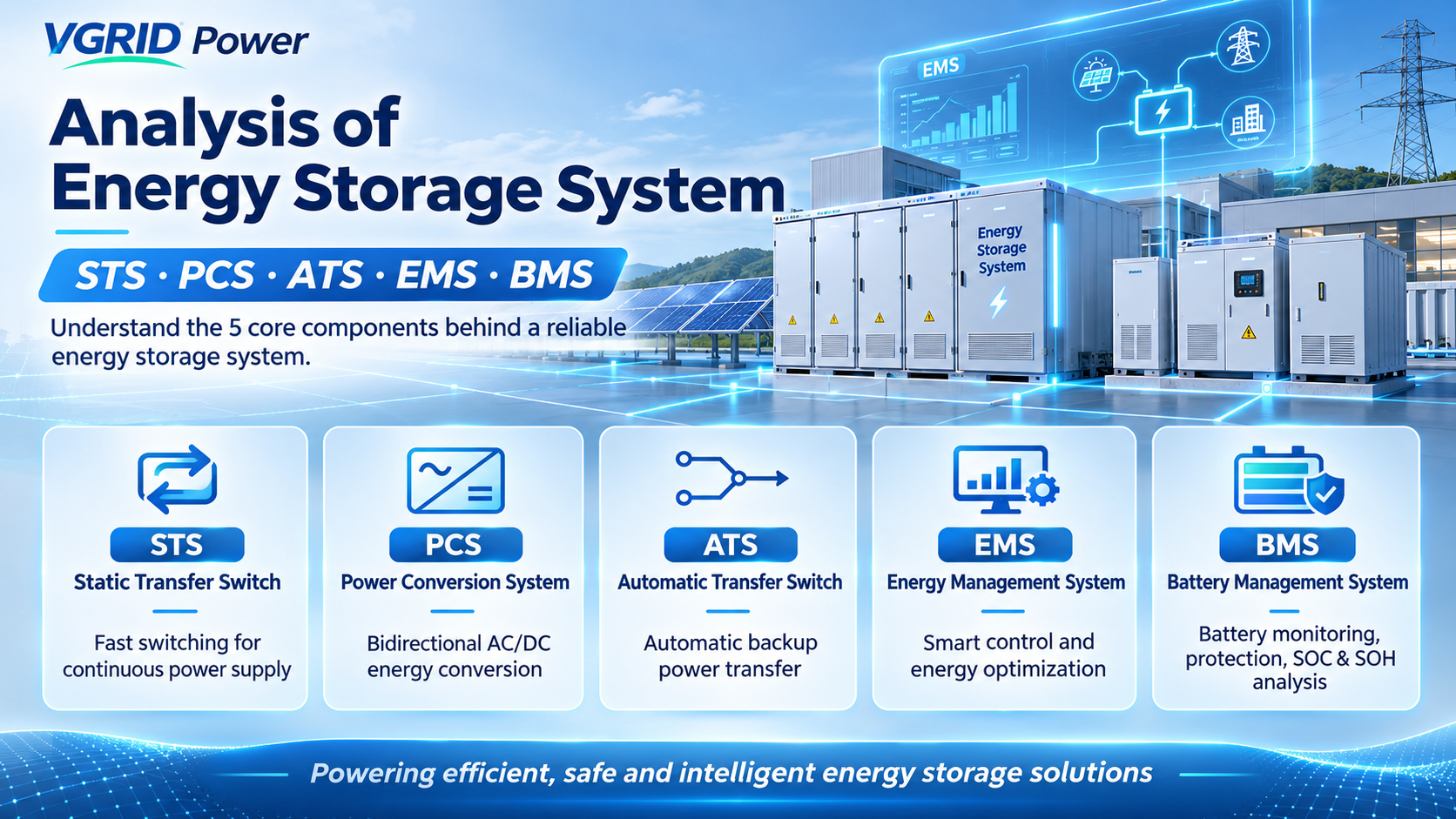
Analysis of energy storage system STS, PCS, ATS, EMS, BMS
Analysis of energy storage system STS, PCS, ATS, EMS, BMS
STS, PCS, ATS, EMS and BMS in an Energy Storage System
An energy storage system combines batteries, power conversion equipment, controls and protection. PCS, BMS, EMS, ATS and STS each perform a different role. Their exact connections depend on the system design.
PCS: Power Conversion System
The PCS converts DC power from the battery to AC power for loads or the grid. A bidirectional PCS also converts AC to DC to charge the battery. Depending on its design and configuration, it can operate on-grid, off-grid or in both modes.
BMS: Battery Management System
The BMS monitors battery conditions such as cell voltage, temperature and current. It reports state of charge and battery status, manages cell balancing where supported, and requests protection actions when operating limits are exceeded. The BMS and PCS must use compatible communication protocols and settings.
EMS: Energy Management System
The EMS coordinates the system according to operating priorities and available measurements. For example, it may schedule battery charging, manage peak demand or coordinate solar generation and a generator. It sends commands within the limits reported by the BMS and the capabilities of the PCS and other equipment.
ATS: Automatic Transfer Switch
An ATS selects between two AC sources, such as the grid and a generator, according to its control scheme. The switching arrangement must prevent unintended connection of sources unless the equipment and design explicitly support it. Transfer time depends on the selected device and application.
STS: Static Transfer Switch
An STS uses power semiconductor switches to transfer a load between suitable AC sources. It can provide fast transfer when the sources and equipment satisfy its design requirements. Transfer time and suitability for a particular load must be checked against the device specification; uninterrupted operation cannot be assumed for every installation.
How the components work together
In a solar and battery microgrid, solar generation can supply the loads and, when the system is configured for it, charge the battery. The BMS communicates battery limits; the EMS uses these limits and system measurements to set operating commands; the PCS controls power conversion. An ATS can select a grid or generator source, while an STS may be used where the load and power sources require a compatible fast-transfer arrangement. PV converters, switches and control functions depend on the project configuration.
ATS vs STS: which should a project use?
Selection depends on source characteristics, load sensitivity, acceptable interruption time, fault protection and cost. Review the transfer equipment's specifications and the complete electrical design with the system integrator before choosing.
Frequently asked questions
1、What is the difference between a PCS and a BMS?
The PCS converts and controls electrical power; the BMS monitors and protects the battery and communicates its operating limits.
2、Does every energy storage system need an EMS?
Not every installation uses a separate EMS. Coordination may be provided by another controller, depending on the system's size, equipment and operating requirements.
3、Are ATS and STS interchangeable?
They both switch AC sources, but their switching technology, source requirements and transfer characteristics differ. Selection requires a project-specific design review.
VGRID Power Technology Co., Ltd. is a company dedicated to the research and development, manufacturing, sales, and service of energy storage system PCS modules and optical reserve all-in-one machinesHigh tech enterprises. The company is located in GuangMing District, Shenzhen. The core team of the company originates from Emerson and has a senior, professional, and efficient team composition. The company focuses on the research and manufacturing of energy storage inverter PCS modules and optical reserve all-in-one machines, providing customers with standard products and PCS system solutions. The company adheres to customer centricity, with professionalism and service as the core, and provides customers with trustworthy products and services.
No products in this category yet.
よくある質問
1. What is the difference between STS and ATS in an energy storage system?
STS (Static Transfer Switch) uses power electronic components to switch between power sources, providing fast transfer for critical loads. ATS (Automatic Transfer Switch) typically uses contactors or mechanical switching mechanisms to transfer loads between the main and backup power supplies. The choice depends on switching speed, load requirements, and system design. 2. What is the main function of a PCS in an energy storage system? PCS (Power Conversion System) is the core component of an energy storage system. It enables bidirectional energy conversion between AC and DC, controlling battery charging and discharging while managing power flow between the battery, grid, and loads. 3. What does an EMS do in a battery energy storage system? EMS (Energy Management System) monitors and manages the overall operation of an energy storage system. It optimizes charging and discharging strategies, improves energy efficiency, monitors system operating conditions, and helps extend battery service life. 4. Why is a BMS important for an energy storage system? BMS (Battery Management System) monitors battery voltage, current, and temperature to ensure safe operation. It provides overcharge and over-discharge protection, monitors battery health (SOH), calculates state of charge (SOC), and helps extend battery lifespan. 5. How do STS, PCS, ATS, EMS, and BMS work together in a microgrid energy storage system? These components work together to ensure stable, efficient, and reliable energy management. The PCS controls power conversion, the EMS manages overall energy distribution, the BMS protects and monitors the battery, while the STS and ATS manage power source switching to maintain continuous power supply.